
ICCS - Theory
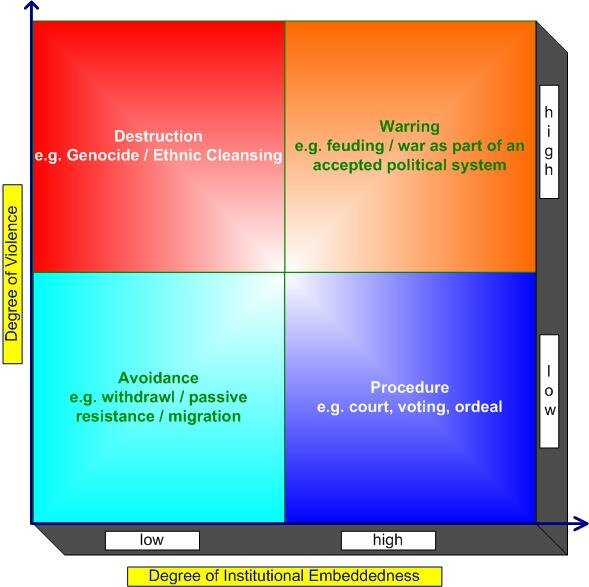
We treat conflicts and institutions as empirically assessable social phenomena. They are universal in the sense that all societies have to come to terms with conflict and all societies develop rules that organise at least to some extent the cohabitation and interaction between its elements. Societies without conflict or without institutions are theoretically implausible and empirically not observed.
Institutions and conflicts are established concepts of social theory. The relationship between the two has, however, rarely been the subject of theoretical scrutiny. For institution centred conflict research, this interdependence needs to be synthesised from conflict theory and institution theory. Our points of departure are the conflict-theoretical ideas of Georg Elwert on the one hand and the neo-institutionalist school of thought with representatives like Douglas North or the Max Planck Institute for the Study of Societies.
From there, a strong but ambivalent nexus between institutions and conflicts in society is likely: conflicts may facilitate or weaken social cohesion; institutions may cause disruptive conflicts or facilitate cooperation and predictable conflict processing.
To deal with this complex relationship between conflict and institutions from a theoretical point of view, we first develop a model of social order based on institutional theory. The model is of intermediate abstraction, placed between historically contingent choices of actors and the detached determinism of social systems in equilibrium.
Subsequently, we build on a conflict-theoretical suggestion of Georg Elwert to differentiate four general ideal types of conflict processing that are defined by the degree of violence involved on the one hand, and the degree of institutional embedding on the other hand. The resulting four-field-matrix is used to model the relationship between institutions and conflict in its impact on dynamic social order.
Operationalising social order

Based on the theoretical approach outlined earlier we develop the method of institution centred conflict research. This method is organised in research modules that take different but complementing analytical perspectives on conflict processes. The perspectives aim at different phenomena that limit the paths conflicts may take and constrain the choices parties to a conflict may take. In conflict contingency and arbitrariness are reduced by (1) the conflict arena with its case specific issue areas, fault lines, context and history, (2) the constellation of actors and their power vis-à-vis one another, (3) the resources actors are targeting or are mobilising in order to win, and, last but certainly not least, (4) the prevailing rules of the game, i.e. institutions.